Tuesday, March 18, 2014

Page - 13

Church of All Nations
Jerusalem

Monday, ‎December ‎23, ‎2013

Third Day of my Holy Land Trip, Jerusalem

My Holy Land Trip

Church of All Nations, Jerusalem

Church of All Nations, 
left side of the church is Garden of Gethsemane 
Basilica of Agony (Church of All Nations)

A Catholic Franciscan church, one of the most magnificent churches in the Holy Land. This place, Gethsemane on the foothill of Mount of Olives, was the site where Jesus had his last prayer before he was  betrayed and arrested.


In the idyllic setting of Gethsemane, one of the most evocative sights in all Jerusalem, rises the Church of All Nations, built by the Italian architect Antonio Barluzzi between 1919 and 1924. The church, known also as the Basilica of the Agony, in reference to the night that Christ spent there on the eve of his Passion, blends the architectural lines typical of the Christian basilica (the facade) with the salient features of Islamic buildings (sides, and roof with numerous small domes).

Church of All Nations, 
a view from the Garden of Gethsemane

The name "Church of All Nations" commemorates the contributions made by many countries to its construction. The flags of the nations are represented inside the little domes which give the whole a distinctly oriental tone. On the site of the present church there raised first a fourth century Byzantine church, later transformed by the Crusaders into a basilica.


A Catholic Franciscan church, built in 1924 by donations from many nations (hence one of its names). It is one of the most magnificent churches, located on the east bank of valley Kidron at the foothill of Mount of Olives. The front of the church, facing the temple mount, is covered by a large mosaic picture. According to the new testament, this place was the site where Jesus  had his last prayer before he was   betrayed and arrested by the Romans.

Main Entrance of The Church of All Nations,
(Church of the Agony)

The facade, enclosed by an elegant wrought iron fence, stands at the top of a flight of steps. A mass of pillars supports the great arches surrounding the atrium, while the tympanum is adorned with a modern mosaic representing Jesus as the Link between God and the Human Race. Inside, some remnants of the mosaic paving document the existence of the ancient Byzantine church. The presbytery is the part of the church which most attracts the attention, since a large fragment of the rock on which Jesus is supposed to have prayed the night before the Passion can be seen in front of the high altar. The rock is entirely surrounded by a crown of thorns in wrought iron. In the lunette in the apse is a mosaic representing Christ in Agony being consoled by an Angel. In the side apses are other mosaic representations of episodes in Jesus' passion, such as the Kiss of Judas and the Arrest of Jesus.


In the view, The Church of All Nations, 
left side of the church is Garden of Gethsemane


The church is built on the lower western foothills of  Mount of Olives, facing the old city of Jerusalem, on the eastern side of Kidron valley.  Its name (Gat Shemanim - means in Hebrew: oil press) came from the olive press that was used to process the olives.


The church is located on the junction of 3 roads - to the old city via Lions gate, the road up Mount Olives, and the road to Jericho.
On this rock Jesus prayed short before being found
and caught by the priest soldiers, betrayed by Juda,
Inside the Church of All Nations, Jerusalem,
next to Garden of Gethsemane

Another view of the rock where Jesus prayed
Inside the Church of All Nations


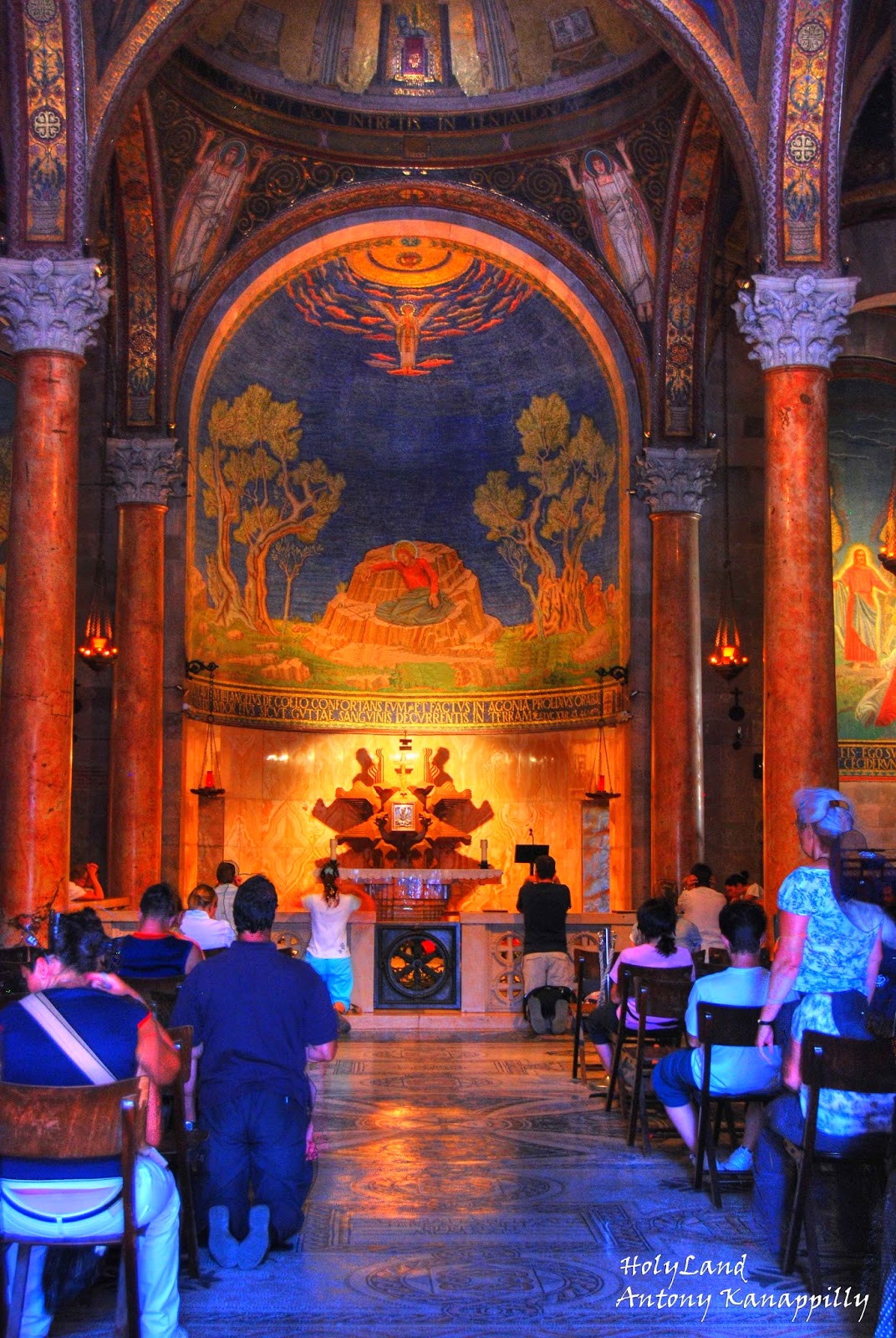
The photo below shows the main altar inside the basilica, which faces the east. The painting illustrates the moment when Jesus secluded in his prayer, on the Holy rock, and flanked by the olive trees.


The Dome of the Rock and the Golden Gate of Jerusalem,
View taken from the Church of All Nations

Another view of the main altar inside the basilica

Explanations about the Gethsemane complex, 
Inside the Church of All Nations

The natural grotto, about 190 square meters in area, is basically unchanged from the time of Jesus. It is believed to be where the disciples slept while Jesus prayed, and where Jesus was betrayed by Judas and arrested. It may also be the location of Jesus’ night-time meeting with Nicodemus (John 3:1-21)

Explanations about the Gethsemane complex, 
Inside the Church of All Nations
Walkway from the Church of All Nations,
next to Garden of Gethsemane

Bell Tower Near by the Church of All Nations,
next to Garden of Gethsemane
Grotto where the disciples slept


Access to the Grotto of Gethsemane is along a narrow walled 
passageway leading to the right from the open courtyard in front of the Tomb of Mary.
On the way to the Grotto of Gethsemane,
The Church of the Assumption at the Mt Olives

Right side of the entrance leads to the grotto of Gethsemane
Entrance to the Grotto of Gethsemane, Jerusalem
View from the Church of the Assumption

Entrance to the Grotto of Gethsemane, Jerusalem

Entrance to the Grotto of Gethsemane, Jerusalem
The picture shows below, our first mass in holy land, chapel inside the grotto of Gethsemane where the disciples slept while Jesus prayed in the garden of Gethsemane


The picture shows below, our first mass in holy land, chapel inside the grotto of Gethsemane where the disciples slept while Jesus prayed in the garden of Gethsemane

The picture shows below, Fr. Dansy, my companion in Holy Land, chapel inside the grotto of Gethsemane where the disciples slept while Jesus prayed in the garden of Gethsemane

The picture shows below, Altar inside the grotto of Gethsemane where the disciples slept while Jesus prayed in the garden of Gethsemane

The picture shows below, Altar inside the grotto of Gethsemane where the disciples slept while Jesus prayed in the garden of Gethsemane

Inside the Grotto,
where the disciples slept while Jesus prayed


Sunday, March 16, 2014

Page - 12

The Garden of Gethsemane

Monday, ‎December ‎23, ‎2013
Continued ....
Third Day of my Holy Land Trip, Jerusalem

My Holy Land Trip


Jerusalem Is a place where Jesus spent His lifetime mostly, and I never felt enough walking and visiting Holy places there.


Jerusalem: the name itself evokes an idea of universality and peace reaching beyond nationalisms, racial disputes, religious faiths and political barriers.

Jerusalem has always been the crossroads between different races and worlds. Concentrated in only a few hundred feet are Al-Aqsa Mosque, Holy Sepulcher, and Wailing Wall the most important sacred sites of the three principal monotheistic religions.

It was a springtime Sunday in about the year 30 A.D. The holy city of Jerusalem was crowded with pilgrims who had come for the annual Passover celebration.

Jesus had spent many months traveling through the towns and villages of Palestine. He preached about the kingdom of God and healed the sick wherever He went. Now the time had come for Him to claim His title as the Messiah - the Savior that God had promised to the Jewish people.

Jesus knew His mission was almost finished. As they traveled to Jerusalem, Jesus warned His disciples that He would soon be put to death, and after three days He would rise again.

As they came near Jerusalem, Jesus told two of His disciples to go into a nearby village and bring a donkey that would be waiting there. Jesus rode into Jerusalem on the donkey. Crowds of people spread their coats on the ground in front of Him. Some waved branches of palm trees, a sign of victory. The people shouted,


Hosanna!
Blessed is the one who comes in the name of the Lord –
the King of Israel!


Only a king would be greeted this way (2 Kings 9:13), and the people wanted Jesus to be their king.Most of the people did not understand what kind of king Jesus would be. They expected their Messiah to be a great political and military leader who would free them from the tyranny of the Roman Empire. But the kingdom of God is not of this world. It is a spiritual kingdom that is now growing in the hearts of people who put their faith and trust in God

The Garden of Gethsemane is just walk away from Church of Dominus Flevit, and my next Holy place to visit.

The entrance The Garden of Gethsemane:

The entrance The Garden of Gethsemane
The entrance to the complex is on the north side, which opens to the north garden. The title reads "Hortus Gethsemane" - the garden of Gethsemane.

Above the name is symbol of the Franciscans, the custodians of  the Holy sites.  Their symbol is a large cross with four crosses on each of its corners. This symbol was the Crusaders sign of Jerusalem, and was adapted by the Franciscans. The 5-cross symbol is based on the 5 Holy wounds of the crucifixion  of Jesus (2 in the hands, 2 in the legs, and one in the chest).

A very old Olive Tree in the background

The garden of Gethsemane, near the foot of the Mount of Olives, is named in the New Testament as the place where Jesus went with his disciples to pray the night before he was crucified.

The garden, about 1200 square metres in area, was well known to the disciples as it is close to the natural route from the Temple to the summit of the Mount of Olives and the ridge leading to Bethany.

The name in Hebrew means “oil press”. Oil is still pressed from the fruit of eight ancient and gnarled olive trees that give the garden a timeless character.

Beside the garden is the Church of All Nations. built over the rock on which Jesus is believed to have prayed in agony before he was betrayed by Judas Iscariot.
About 100 meters north of the church is the Grotto of Gethsemane, where Jesus and his disciples often camped at night. In this natural grotto, it is believed, the disciples slept while Jesus prayed, and Jesus was betrayed by Judas and arrested.
Near the grotto is the Tomb of Mary, where a Christian tradition holds that the Mother of Jesus was buried after she “fell asleep” in death


How old are the trees?

In the garden of Gethsemane, behind a fence of iron tracery with Byzantine motifs stand the gnarled trunks of eight hoary olive trees. They create a spiritual atmosphere for visitors to the garden of Gethsemane, although the flower beds and paths around them introduce an artificial element...


The trees also generate conjecture about their age. Were they silent witnesses to the Agony of Jesus the night before he died?

Israel has many ancient olive trees. Two in the town of Arraba and five in Deir Hanna have been determined to be over 3000 years old.


The present Gethsemane trees, however, were not standing at the time of Christ. The historianFlavius Josephus reports that all the trees around Jerusalem were cut down by the Romans for their siege equipment before they captured the city in AD 70.
Research reported in 2012 showed that three of the eight ancient trees (the only ones on which it was technically possible to carry out the study) dated from the middle of the 12th century, and all eight originated as cuttings from a single parent tree.


The Gethsemane olives are possibly descendants of one that was in the garden at the time of Christ. This is because when an olive tree is cut down, shoots will come back from the roots to create a new tree.
In 1982 the University of California carried out radiocarbon-dating tests on some root material from Gethsemane. The results indicated that some of the wood could be dated at 2300 years old.


What happens to the fruit from the Gethsemane olive trees? When it is harvested each year, the oil is pressed for Gethsemane’s sanctuary lamps and the pits are used to make rosary beads, given by the Franciscan Custos of the Holy Land to notable pilgrims.


The main importance of the garden of Gethsemane is that it is the place where Jesus Christ showed his passion for the world by accepting to be crucified for the world's sins.


What Gethsemane means

The Garden of Gethsemane, on the side of the Mount of Olives in Jerusalem, is where Jesus went to pray before His ordeal on the cross of Calvary.

The Bible says that Jesus was troubled and overwhelmed with sorrow, to the point of sweating drops of blood. Three times Jesus prayed that if it were possible the cup of suffering would be taken from Him, but that the will of the Father would nevertheless be done.

Chapter 12 of the book of Hebrews tells us that Jesus “endured the cross, scorning its shame” and that He did this “for the joy set before Him”. In other words, although He was under immense pressure, and in torment at the suffering He was undergoing, He pressed on, firstly, because it was the will of the Father and, secondly, because, by faith, He knew that He would have great joy on the other side of the suffering.

The setting of His spiritual travail before the crucifixion, at Gethsemane, and even the name of the place, is deep with meaning.


Matthew 26:36-46, Then Jesus went with his disciples to a place called Gethsemane, and he said to them, “Sit here while I go over there and pray.” 37 He took Peter and the two sons of Zebedee along with him, and he began to be sorrowful and troubled. 38 Then he said to them, “My soul is overwhelmed with sorrow to the point of death. Stay here and keep watch with me.” 39 Going a little farther, he fell with his face to the ground and prayed, “My Father, if it is possible, may this cup be taken from me. Yet not as I will, but as you will.” 40 Then he returned to his disciples and found them sleeping. “Could you men not keep watch with me for one hour?” he asked Peter. 41 “Watch and pray so that you will not fall into temptation. The spirit is willing, but the body is weak.” 42 He went away a second time and prayed, “My Father, if it is not possible for this cup to be taken away unless I drink it, may your will be done.” 43 When he came back, he again found them sleeping, because their eyes were heavy. 44 So he left them and went away once more and prayed the third time, saying the same thing. 45 Then he returned to the disciples and said to them, “Are you still sleeping and resting? Look, the hour is near, and the Son of Man is betrayed into the hands of sinners. 46 Rise, let us go! Here comes my betrayer!


Saturday, March 15, 2014

Page - 11

The Church of Dominus Flevit

Monday, ‎December ‎23, ‎2013
Continued ....
Third Day of my Holy Land Trip, Jerusalem

My Holy Land Trip

A view from the Rehavam Observation Point,
Dome of the Rock, the Old City of Jerusalem, and the Jewish cemetery
From Pater Noster Church, we went to the Church of Dominus Flevit. The church is built on the lower western foothills of Mount of Olives, facing the old city of Jerusalem, on the eastern side of Kidron valley.  It is accessed by foot through a steep walkway, from either the top of Mt olives or from the bottom near the Basilica of Agony and Mary's Tomb.

On the way to Church of Dominus Flevit, there are many inmportant palces to see. A beautiful vision of Dome of the Rock, the Old City of Jerusalem, and the Jewish cemetery from the Rehavam Observation Point.

A view from the Rehavam Observation Point,
Dome of the Rock, the Old City of Jerusalem, and the Jewish cemetery
 
A view from the Rehavam Observation Point,
Dome of the Rock, the Old City of Jerusalem, and the Jewish cemetery
A seen from Palm Sunday street, 
on the way to Church of Dominus Flevit

On Palm Sunday street


Glory, praise and honor,
O Christ, our Savior-King,
To thee in glad Hosannas
Inspired children sing.

Palm Sunday: In the accounts of the four canonical Gospels, Jesus' triumphal entry into Jerusalem takes place about a week before his Resurrection.
The symbolism is captured in Zechariah 9:9 "The Coming of Zion's King – See, your king comes to you, righteous and victorious, lowly and riding on a donkey, on a colt, the foal of a donkey". It was perceived that Jesus was declaring he was the King of Israel to the anger of the Sanhedrin.
According to the Gospels, Jesus rode a donkey into Jerusalem, and the celebrating people there laid down their cloaks in front of him, and also laid down small branches of trees. The people sang part of Psalm 118: 25–26 – ... Blessed is He who comes in the name of the Lord. We bless you from the house of the Lord ....
The symbolism of the donkey may refer to the Eastern tradition that it is an animal of peace, versus the horse, which is the animal of war.[1] A king came riding upon a horse when he was bent on war and rode upon a donkey when he wanted to point out he was coming in peace. Jesus' entry to Jerusalem would thus symbolize his entry as the Prince of Peace, not as a war-waging king.
In Luke 19:41 as Jesus approaches Jerusalem, he looks at the city and weeps over it (an event known as Flevit super illam in Latin language), foretelling the suffering that awaits the city.

On Palm Sunday street
A Jewish cemetery beside the Palm Sunday Street

The Church of Dominus Flevit

Jerusalem

Dominus Flevit, ("the Lord  has wept")


A Catholic Franciscan church,  on the foothill of Mount of Olives, where Jesus visualizes the destruction of Jerusalem and cries.  The church is shaped as a tear drop.


A Roman-Byzantine necropolis was also excavated at the site, revealing rich findings.
Luke 19, 41: "...he beheld the city, and wept over it."
At the gate of Dominus Flevit Church,
on Palm Sunday Street, Jerusalem 
Near to the Dominus Flevit Church, 
on Palm Sunday Street, Jerusalem
Near to the Dominus Flevit Church, 
on Palm Sunday Street, Jerusalem
Cross of Jewish showing on the door at the
gate of The Church of  Dominus Flevit. 


The 5-cross symbol is based on the 5 Holy wounds of the crucifixion of Jesus (2 in the hands, 2 in the legs, and one in the chest).
Olive Trees near the Church of Dominus Flevit.
It was an olive leaf that a dove from Noah's ark brought to Noah, "Then the dove came to him in the evening, and behold, a freshly plucked olive leaf was in her mouth; and Noah knew that the waters had receded from the earth" (Gen. 8:11)

One of the most remarkable trees is the olive tree. Most of us are not too familiar with olive trees because they don't grow near where we live. However, in the land of the Bible, it was, and is, the most important of all the trees because it is a source of food, light, hygiene and healing.

Russian Orthodox Church of Mary Magdalene (Golden Dome)
view from near the Church of Dominus Flevit, Mount of Olives
Russian Orthodox Church of Mary Magdalene (Golden Dome)
view from near the Church of Dominus Flevit, Mount of Olives

The Basilica of the Dormition, Mount Zionview from near the Church of Dominus Flevit, Mount of Olives


“As he approached Jerusalem and saw the city, he wept over it and said, “If you, even you, had only known on this day what would bring you peace—but now it is hidden from your eyes. The days will come upon you when your enemies will build an embankment against you and encircle you and hem you in on every side. They will dash you to the ground, you and the children within your walls. They will not leave one stone on another, because you did not recognize the time of God’s coming to you.” (Luke 19:41-44)


The Church of Dominus Flevit


The church is built on the lower western foothills of Mount of Olives, facing the old city of Jerusalem, on the eastern side of Kidron valley. It is accessed by foot through a steep walkway, from either the top of Mt olives or from the bottom near the Basilica of Agony and Mary's tomb.
In front of the Church of Dominus Flevit, Mt Olive, Jerusalem

This is the view of the church from the west side.
The church is structured as a tear drop in the form of a cross. It is a design of the Italian famous church architect, Antonio Barluzzi, who also designed other churches such as the Mount of Beatitudes, Visitation church in Ein Karem and Basilica of Agony.  The church was built in 1954.