Showing posts with label Jerusalem. Show all posts

Tuesday, March 18, 2014

Page - 13

Church of All Nations
Jerusalem

Monday, ‎December ‎23, ‎2013

Third Day of my Holy Land Trip, Jerusalem

My Holy Land Trip

Church of All Nations, Jerusalem

Church of All Nations, 
left side of the church is Garden of Gethsemane 
Basilica of Agony (Church of All Nations)

A Catholic Franciscan church, one of the most magnificent churches in the Holy Land. This place, Gethsemane on the foothill of Mount of Olives, was the site where Jesus had his last prayer before he was  betrayed and arrested.


In the idyllic setting of Gethsemane, one of the most evocative sights in all Jerusalem, rises the Church of All Nations, built by the Italian architect Antonio Barluzzi between 1919 and 1924. The church, known also as the Basilica of the Agony, in reference to the night that Christ spent there on the eve of his Passion, blends the architectural lines typical of the Christian basilica (the facade) with the salient features of Islamic buildings (sides, and roof with numerous small domes).

Church of All Nations, 
a view from the Garden of Gethsemane

The name "Church of All Nations" commemorates the contributions made by many countries to its construction. The flags of the nations are represented inside the little domes which give the whole a distinctly oriental tone. On the site of the present church there raised first a fourth century Byzantine church, later transformed by the Crusaders into a basilica.


A Catholic Franciscan church, built in 1924 by donations from many nations (hence one of its names). It is one of the most magnificent churches, located on the east bank of valley Kidron at the foothill of Mount of Olives. The front of the church, facing the temple mount, is covered by a large mosaic picture. According to the new testament, this place was the site where Jesus  had his last prayer before he was   betrayed and arrested by the Romans.

Main Entrance of The Church of All Nations,
(Church of the Agony)

The facade, enclosed by an elegant wrought iron fence, stands at the top of a flight of steps. A mass of pillars supports the great arches surrounding the atrium, while the tympanum is adorned with a modern mosaic representing Jesus as the Link between God and the Human Race. Inside, some remnants of the mosaic paving document the existence of the ancient Byzantine church. The presbytery is the part of the church which most attracts the attention, since a large fragment of the rock on which Jesus is supposed to have prayed the night before the Passion can be seen in front of the high altar. The rock is entirely surrounded by a crown of thorns in wrought iron. In the lunette in the apse is a mosaic representing Christ in Agony being consoled by an Angel. In the side apses are other mosaic representations of episodes in Jesus' passion, such as the Kiss of Judas and the Arrest of Jesus.


In the view, The Church of All Nations, 
left side of the church is Garden of Gethsemane


The church is built on the lower western foothills of  Mount of Olives, facing the old city of Jerusalem, on the eastern side of Kidron valley.  Its name (Gat Shemanim - means in Hebrew: oil press) came from the olive press that was used to process the olives.


The church is located on the junction of 3 roads - to the old city via Lions gate, the road up Mount Olives, and the road to Jericho.
On this rock Jesus prayed short before being found
and caught by the priest soldiers, betrayed by Juda,
Inside the Church of All Nations, Jerusalem,
next to Garden of Gethsemane

Another view of the rock where Jesus prayed
Inside the Church of All Nations


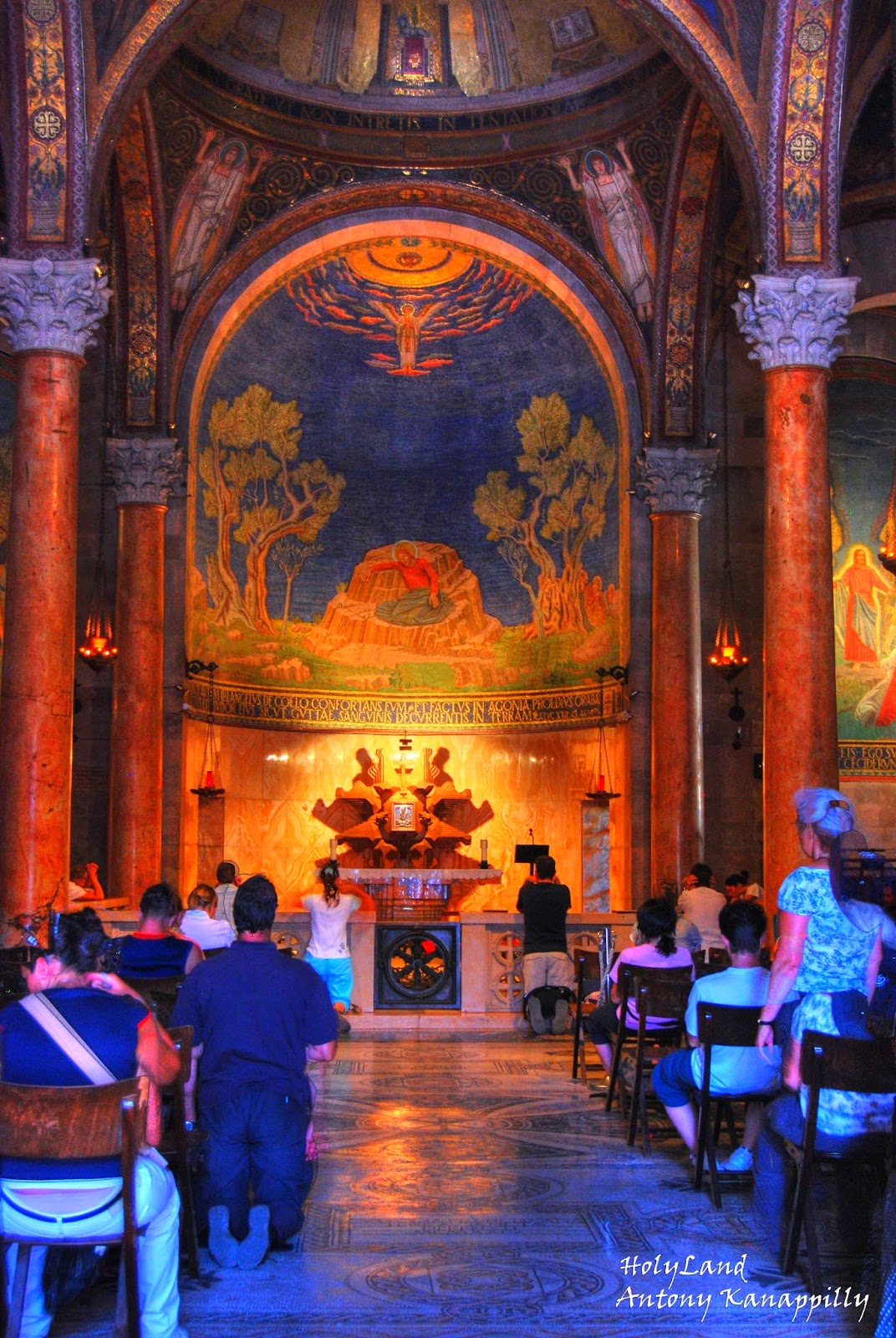
The photo below shows the main altar inside the basilica, which faces the east. The painting illustrates the moment when Jesus secluded in his prayer, on the Holy rock, and flanked by the olive trees.


The Dome of the Rock and the Golden Gate of Jerusalem,
View taken from the Church of All Nations

Another view of the main altar inside the basilica

Explanations about the Gethsemane complex, 
Inside the Church of All Nations

The natural grotto, about 190 square meters in area, is basically unchanged from the time of Jesus. It is believed to be where the disciples slept while Jesus prayed, and where Jesus was betrayed by Judas and arrested. It may also be the location of Jesus’ night-time meeting with Nicodemus (John 3:1-21)

Explanations about the Gethsemane complex, 
Inside the Church of All Nations
Walkway from the Church of All Nations,
next to Garden of Gethsemane

Bell Tower Near by the Church of All Nations,
next to Garden of Gethsemane
Grotto where the disciples slept


Access to the Grotto of Gethsemane is along a narrow walled 
passageway leading to the right from the open courtyard in front of the Tomb of Mary.
On the way to the Grotto of Gethsemane,
The Church of the Assumption at the Mt Olives

Right side of the entrance leads to the grotto of Gethsemane
Entrance to the Grotto of Gethsemane, Jerusalem
View from the Church of the Assumption

Entrance to the Grotto of Gethsemane, Jerusalem

Entrance to the Grotto of Gethsemane, Jerusalem
The picture shows below, our first mass in holy land, chapel inside the grotto of Gethsemane where the disciples slept while Jesus prayed in the garden of Gethsemane


The picture shows below, our first mass in holy land, chapel inside the grotto of Gethsemane where the disciples slept while Jesus prayed in the garden of Gethsemane

The picture shows below, Fr. Dansy, my companion in Holy Land, chapel inside the grotto of Gethsemane where the disciples slept while Jesus prayed in the garden of Gethsemane

The picture shows below, Altar inside the grotto of Gethsemane where the disciples slept while Jesus prayed in the garden of Gethsemane

The picture shows below, Altar inside the grotto of Gethsemane where the disciples slept while Jesus prayed in the garden of Gethsemane

Inside the Grotto,
where the disciples slept while Jesus prayed


Wednesday, March 12, 2014

Page - 9

Jerusalem

Monday, ‎December ‎23, ‎2013
Continued ....
Third Day of my Holy Land Trip, Jerusalem

My Holy Land Trip

Hotel Ararat, Bethlehem, View from our bus,
Monday, ‎December ‎23, ‎2013, ‏‎8.06 AM
Today, 23 December, visiting the first place is Dome of the Ascension (Chapel of Ascension). An octagon chapel on Mt Olives built over ancient structures. According to tradition, this sacred site is where Jesus ascended to heaven 40 days after resurrection.

An octagon chapel on Mt Olives built over ancient structures. According to tradition, this sacred site is where Jesus ascended to heaven 40 days after resurrection.


Seen on the way to the 
Dome of the Ascension (Chapel of Ascension)
Mount Olive
City of Jerusalem


JerusalemAccording to the Bible, before King David's conquest of Jerusalem in the 11th century BCE the city was home to the Jebusites. The Bible describes the city as heavily fortified with a strong city wall. The city ruled by King David, known as Ir David, or the City of David, was southwest of the Old City walls, outside the Dung Gate. His son King Solomon extended the city walls and then, in about 440 BCE, during the Persian period, Nehemiah returned from Babylon and rebuilt them. In 41-44 CE, Agrippa, king of Judea, built a new city wall known as the "Third Wall."
Near to Jaffa Gate, City of Jerusalem


Mar Elias Monastery, Bethlehem

Mar Elias Monastery, Bethlehem

This Greek Orthodox Monastery stands like a fortress on a hill from which both Jerusalem and Bethlehem can be seen. Mar Elias Monastery is located 5 km to the north of Bethlehem on the way to Jerusalem, and was founded in the 6th century AD and rebuilt by the Emperor Manual Communes in 1160.

Bell Tower of the Mar Elias Monastery,
on the side of the road from Bethlehem to Jerusalem

Legend has it that the building stands on the site where prophet rested on his flight from the Vengeance of Queen Jezebel, who was seeking vengeance after Elijah slaughtered the priests of Baal (1 Kings 19:15). Another tradition holds that Greek Bishop Elias of Bethlehem was buried here in 1345, and another holds that it places the sepulcher of St. Elias, an Egyptian monk who became Patriarch of Jerusalem in 494.

Mar Elias is believed to answer the prayers of barren women and ailing children. From the monastery, Bethlehem can be seen to the south, Herodion to the southeast and sometimes the Dead Sea across the valley to the east.
Back side of the Mar Elias Monastery,
on the side of the road from Bethlehem to Jerusalem,  

Dome of the Ascension


This admirable building blends the architectural features of the Crusader style with traits belonging to the Muslim tradition. The chapel rises on the site of an ancient paleo-Christian sanctuary, near the top of the Mount of Olives.


The ruins of the chapel is located in the suburb of A-Tur, on the east side of the main road of the top of Mount of Olives, at 830M above sea level.

Near the Ascension chapel is the Russian Orthodox Church of the Ascension, which is another traditional site of the ascension. It is located near a tall tower inside the village of A-Tur


The original building was surrounded by a double portico forming a circle. Destroyed by the Persians in the 614, it was rebuilt by the Crusaders in the form of a small, octagonal temple (twelfth century).

Having come under the control of Muslims, to whom it has belonged since the thirteenth century, the building was converted into a mosque and completely transformed by walling in the arches and roofing over the octagon with a little dome of evident Islamic character.

On a rock inside can be seen a footprint which is identified according to Christian tradition as the print that Jesus left as he ascended to Heaven: "And he led them out as far as to Bethany, and he lifted up his hands, and blessed them. And it came to pass, while he blessed them, he was parted from them, and carried up into heaven" (Luke, 24 50-51).

Footprint print of Jesus
Tower in the Background is - Minaret of the Mosque of the Ascension